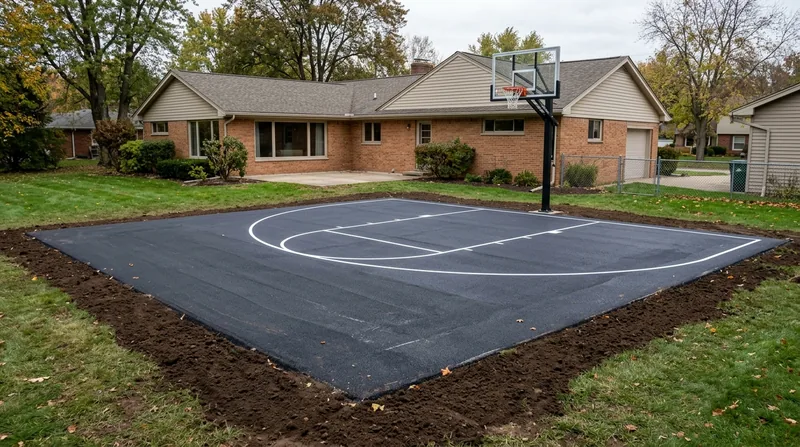




Sports Court & Path Paving in Cleveland means building a court or path surface that survives the freeze-thaw cycle running under the lake plain and glacial till that dominates Greater Cleveland's terrain. Backyards in Cleveland's inner-ring suburbs, from Shaker Heights to Parma, sit on fine silt and clay near Lake Erie or on dense glacial till behind the escarpment, both of which heave hard when frost works into them. A basketball or tennis court that sits on bare ground or a thin gravel pad will crack, pitch, and separate within a season or two. We grade the lot, build a compacted aggregate base engineered for the 42-inch design frost depth that defines this region, and pour asphalt level enough to play on. The result is a court or path that stays flat and playable through the winter thaw cycles that wreck poorly built surfaces.
Why Freeze-Thaw Failure Dominates Backyard Courts in Cleveland
Cleveland's climate and soils create a specific failure mode that generic court builders miss. The lake-plain clay and silt that underlies neighborhoods from Ohio City to Euclid holds water and expands when it freezes. A court base that is not compacted below the frost line will heave unevenly, crack the asphalt above it, and separate at joints where two sections move at different rates. Winter thaw cycles repeat this stress every year, and by spring the court surface is broken. Proper base preparation is not optional in this market, it is the difference between a court that lasts and one that fails.
- Freeze-thaw heave cracks courts built on uncompacted clay or silt within one to two seasons.
- A stable base compacted to the frost line prevents differential movement and keeps the court level.
- Grading and drainage direct water away from the base so frost cannot penetrate as deeply.
- Asphalt poured over a poor base will fail even if the asphalt itself is sound.
This is why courts in Shaker Heights and Cleveland Heights that were built over bare ground crack while courts built with a proper base stay playable for years.
Local example: A residential court in Lakewood built without base compaction cracked in a grid pattern by the second winter. A court two blocks away, built with a four-inch compacted aggregate base, remained flat and playable after five years of the same freeze-thaw cycles.
For more on how base preparation affects durability across all asphalt surfaces in Cleveland, see our page on gravel driveway installation and grading, which covers the same frost-depth engineering for driveway bases.
How We Build a Sports Court in Cleveland: The Process
Our approach starts with the ground, not the asphalt. We begin by understanding the site drainage, the existing soil, and how water moves across the lot after rain or snowmelt. We then grade the surface to slope slightly away from structures and toward drainage points. Next, we bring in compacted crushed stone or recycled asphalt millings and compact each lift to specifications that match the frost depth and load the court will carry. Once the base is stable and level, we pour and finish the asphalt to the thickness and slope the court requires. The entire process is measured and documented so you know what is under the surface.
- We survey the lot and locate utilities before any excavation or grading work begins.
- We grade the site to remove standing water and direct runoff away from the court base.
- We place and compact aggregate base material in lifts to reach the required density and frost protection.
- We set the asphalt thickness based on the court type (basketball, tennis, or path) and expected use.
- We finish the surface level and smooth so the court plays true.
From start to finish, a backyard court typically takes three to five working days, depending on site prep and weather.
Cleveland example: A residential tennis court in Cleveland Heights required removal of a failed gravel pad, regrading to eliminate a low spot that collected water, placement of six inches of compacted recycled asphalt, and a three-inch asphalt finish. The work took four days and created a court that has remained level and playable through three winters.
Related to court and path paving is our work on asphalt driveway paving and installation, which uses the same base-prep discipline for residential driveways across Cleveland.
Sports Court & Path Paving Methods in Cleveland
| Approach | Description | Best for |
|---|---|---|
| Full-depth court build | Grade bare ground, place compacted base to frost depth, pour asphalt finish course. Includes site survey and utility locate. | New courts or failed surfaces where the base is no longer stable. |
| Base repair and overlay | Identify and compact failed base sections, add aggregate where needed, pour new asphalt over the repaired base. | Courts with good asphalt but heaving or cracking from base failure. |
| Recycled asphalt base | Reclaim and recompact existing asphalt or recycled millings as base material, reducing material cost and waste. | Budget-conscious projects where existing asphalt can be salvaged and reused. |
| Pathway and court combination | Build a paved path from the house or garage to the court using the same base and finish standards as the court itself. | Properties where access and safety benefit from a continuous paved surface. |
Each approach is chosen based on what exists on site and what the ground can support after we assess it in person.
Sports Court & Path Paving Cost in Cleveland: What to Expect
A residential basketball or tennis court in the Cleveland area starts at around $8,500 to $12,000 for a full-depth build on a cleared lot with straightforward grading and a standard three-inch asphalt finish. That range covers site survey, utility locate, base compaction to frost depth, and finished asphalt. The cost moves up if the site requires significant regrading, if the base needs to be thicker for intensive use, or if access is tight and equipment must work in stages. A path poured alongside a court or driveway typically runs $3,000 to $5,000, depending on length and width. For a precise number, we measure the site and provide a written estimate that includes tonnage and lift specifications so you understand what is being built.
Factors that affect the final cost include the size of the court, the soil condition and how much grading is needed, whether existing asphalt or stone can be reclaimed and reused, site access and equipment staging, and the thickness of asphalt required for the court type and expected use. Getting two or three estimates from local paving companies is smart because the quality of the base preparation and the thickness of the finish vary significantly, and a low price that skips base compaction is a cost, not a savings.
See our full pricing overview for ranges on other asphalt services, or call us at (216) 238-3742 for a free estimate on your court or path.
Sports Court & Path Paving Near Me: What to Look for When Hiring a Contractor in Cleveland
The strongest signal that a paving contractor is local and trustworthy is a verifiable address and local equipment. Avoid contractors who solicit door-to-door, demand a large cash deposit before starting, have out-of-state plates, or quote a price that is significantly lower than other estimates without explaining why. Ask any contractor you are considering for a written estimate that includes the base thickness, aggregate type, asphalt thickness, and total tonnage. A contractor who can answer questions about frost depth, soil drainage, and why the base matters is one who understands the Cleveland market.
- Verify that the contractor carries full liability insurance and can provide a certificate on request.
- Check references from recent court or driveway projects in your neighborhood or a similar soil type.
- Ask whether the estimate includes the cost of any permits required by your city or village.
- Confirm that the contractor will call 811 for a utility locate before any excavation or grading.
- If your property is in a homeowners association, verify that the court design and materials meet HOA architectural standards.
Permitting and regulations for court construction vary by municipality across Greater Cleveland. Some cities require a permit for any new structure or impervious surface, while others have size or setback thresholds below which a permit is not required. The best practice is to contact your city or village building department before you sign a contract so you understand what is required and what the timeline will be. We help homeowners navigate local permitting and can answer questions about what your municipality requires.
To discuss your court or path project and get a free estimate, contact us or call (216) 238-3742. We serve Cleveland, Lakewood, Parma, Shaker Heights, Cleveland Heights, and surrounding communities across Cuyahoga, Lake, and Summit counties.
Sports Court & Path Paving in Cleveland: Pricing Guide
| Service | Price | Details |
|---|---|---|
| Residential basketball or tennis court | Starting at $8,500 | Full-depth build with compacted base, frost-protected grading, and three-inch asphalt finish on a standard cleared lot |
| Court with significant grading or poor soil | Starting at $10,500 | Additional base compaction, regrading, or thicker aggregate layers required to meet frost depth and drainage |
| Pathway to court or driveway | Starting at $3,000 | Paved walkway with same base and finish standards as the court, cost varies by length and width |
| Base repair and overlay on existing court | Starting at $5,500 | Identify and repair failed base sections, recompact, and pour new asphalt over the existing surface |
| Complex site or custom specifications | On estimate | Large courts, intensive use specifications, or unusual site conditions require on-site measurement and soil assessment |
| Free estimate and site survey | No charge | Response within 24 hours at (216) 238-3742, includes utility locate and written tonnage specifications |
Indicative pricing, the exact cost depends on square footage, finish, and site access. Free personalized estimate within 24h at (216) 238-3742.


