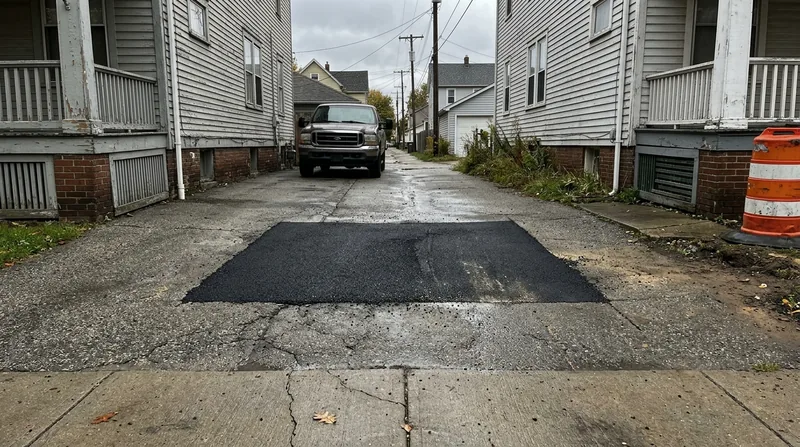




Driveways across Cleveland's near east and west sides crack where lake-plain clay heaves each winter. The freeze-thaw cycle that dominates this region, combined with the city's 42-inch design frost depth and heavy road salt, works into asphalt edges and base layers, opening cracks that spread into alligator patterns by spring. Driveway repair in Cleveland means cutting out failed sections, rebuilding the compacted aggregate base to handle that frost line, and patching with hot mix asphalt sized for the narrow shared drives between century-old frame doubles on the near east and west sides, or the wider single and double-car slabs in the outer city and inner-ring suburbs. We've been doing this since 2010, and we know exactly what the clay and glacial till beneath your driveway will do to asphalt that sits on a thin skin or bare earth. The difference between a patch that holds and one that fails in two years is the base. We build for the frost.
Why Driveway Repair Matters in Cleveland: The Frost Heave Problem
Cleveland sits on two distinct soil types, both of which drain slowly and heave hard in winter. The fine lake-plain clay and silt near Lake Erie, and the dense glacial till on the higher ground behind the escarpment, both absorb water and expand when frozen. When frost works into an asphalt base that was never built deep enough or compacted properly, it lifts the surface unevenly. Thaw comes, the base settles, and the asphalt cracks. A single winter of this cycle can turn a hairline crack into a pothole. The longer the repair waits, the more water infiltrates the base, and the faster the failure spreads.
- We remove all failed asphalt and inspect the base layer to determine if it can be rebuilt or if it must be fully replaced.
- We compact new aggregate base material to the density required for Cleveland's frost depth, not a quick tamp over bare earth.
- We patch with hot mix asphalt, sized to match the width and thickness of your existing driveway.
- We proof-roll the base and check compaction before any asphalt is laid, so the patch will not settle or crack prematurely.
The result is a repair that holds through the next five to ten winters instead of failing again in two years. If your driveway shows extensive alligator cracking across more than thirty to forty percent of the surface, the base is likely gone, and a full resurfacing or replacement is a better investment than patching. We'll tell you which one makes sense when we see the job.
Key info: Homeowners in Lakewood, Parma, and Cleveland Heights often call in spring when frost heave becomes visible. By then, the damage is done. If you see cracks widening or edges breaking away from the street, call now. The sooner we cut out failed sections and rebuild the base, the less water gets into the surrounding asphalt.
For more on how base preparation affects your driveway's lifespan, see our guide to asphalt driveway paving and installation.
How We Handle Driveway Repair in Cleveland: The Process
Every repair starts with a site visit and a measurement. We look at the crack pattern, test the base with a probe, and determine whether we can patch the failed section or whether the damage extends deeper and wider than it appears on the surface. Some cracks are surface only and can be sealed before they spread. Others have failed base underneath, and those require full-depth removal and base rebuild. We give you the honest answer, not the biggest invoice.
- We mark the repair area, typically extending it beyond visible cracks to ensure we remove all weakened asphalt and base.
- We cut a clean edge and remove all failed material, taking the cut down to compacted earth or stable base.
- We haul out the broken asphalt and base and grade the subgrade to positive drainage, so water runs away from the repair.
- We compact new aggregate base in lifts, achieving the density required for your soil type and frost depth.
- We tack the patch edges with asphalt cement and lay hot mix asphalt at the proper temperature and thickness.
- We finish the patch level with the surrounding driveway, so water sheds properly and the transition is smooth for vehicles.
The entire process, from removal to finished patch, typically takes one to three days depending on the size of the failed area and the weather. New asphalt must cure for six to twelve months before it is sealed, and we do not recommend sealcoating immediately after installation. The surface will harden and darken as it cures. Avoid heavy traffic on the patch for the first 48 hours after we finish.
Local example: A shared drive in Ohio City between two frame doubles showed alligator cracking along the center line where clay heave was lifting the joint. We removed the cracked section, rebuilt the base on both sides of the joint, and patched with hot mix. The patch has held through three winters. The key was rebuilding the base deep enough and compacted tight enough to handle the frost.
If your driveway needs more than patching, explore our asphalt resurfacing and overlay service for wider coverage.
Driveway Repair Methods: Matching the Fix to the Damage
| Approach | Description | Best for |
|---|---|---|
| Pothole and crack patching | Remove failed asphalt and base, rebuild compacted aggregate, patch with hot mix sized to the surrounding surface. | Localized failures, single potholes, frost heave cracks, edge breaks at the street or property line. |
| Full-depth patching | Remove asphalt and base to subgrade, inspect and grade the subgrade for drainage, compact new base in lifts, patch with hot mix to original thickness. | Large potholes, multiple failures in one area, base layer that is broken or unstable, patches that have failed before. |
| Alligator cracking repair | Identify the failed area, remove all cracked asphalt and weakened base, rebuild with compacted aggregate and new hot mix. | Widespread surface cracking, base failure affecting thirty to forty percent or less of the driveway surface. |
| Shared drive and apron repair | Patch the failed section, rebuild the joint or edge where two driveways meet, ensure proper slope for drainage between properties. | Cracks at shared property lines, heave at the joint between two driveways, breaks at the street apron where the driveway meets municipal pavement. |
| Resurfacing or overlay (if damage is extensive) | Mill the top layer of asphalt, inspect the base, lay new hot mix asphalt over the existing base if it is stable. | Widespread cracking across more than thirty to forty percent of the surface, base is intact but surface is worn, multiple patches have failed. |
Each method depends on how much of your driveway has failed and how deep the damage reaches. We determine the right approach on site and explain the cost and timeline before we start work.
Driveway Repair Cost in Cleveland: What to Expect
Driveway repair in Cleveland typically starts at $450 for a small pothole or crack repair, but the final cost depends on how much asphalt has failed, how deep the base damage reaches, and how much compacted aggregate must be brought in. A pothole that is isolated and shallow costs less than a large area where the base is broken or where multiple repairs are needed. Shared drives between doubles on the near east and west sides often require careful work at the joint to prevent future heave, which adds time and material. Driveways in the outer city and suburbs with wider surfaces and deeper base layers may cost more if the damage is extensive.
The best way to get an accurate price is to call for a free, no-obligation estimate. We measure the failed area, probe the base, and give you a written estimate with tonnage and thickness specs. We respond within 24 hours at (216) 238-3742. If your driveway shows alligator cracking across more than thirty to forty percent of the surface, a full resurfacing or replacement may be a better value than patching, and we will tell you so. We do not patch driveways that should be replaced. For a detailed breakdown of pricing across all our services, see our full pricing page.
Cost factors: The size of the failed area, the depth of base repair needed, access for equipment, proximity to structures or utilities, and the type of soil all affect the final price. Clay and glacial till require different base preparation depths. Shared drives may require coordination with neighbors. Always get two or three estimates so you can compare price, approach, and warranty terms.
Driveway Repair Near Me: What Cleveland Homeowners Should Know When Hiring a Contractor
Driveway paving and repair attract more scams than almost any other home service. The classic pitch is an unsolicited door-to-door offer from an out-of-state crew with "leftover asphalt from a job nearby," a large cash deposit, no written contract, and a price that is too good to be true. That crew will be gone in a week, and so will your money. Honest contractors are local, have a local address and local plates, provide written estimates with tonnage and thickness specs, and answer the phone when you call back.
- Verify that any contractor carries full insurance and can provide a current certificate of insurance before work begins.
- Get a written estimate that includes the size of the repair, the base depth and material, the thickness of the asphalt, and the total cost.
- Ask for references from recent jobs in your neighborhood, and call them to ask whether the work held up and whether the contractor was easy to work with.
- Check whether your municipality requires a permit for the work, and ask the contractor how they handle permitting. Driveway repairs in Cleveland do not always require a permit, but apron work at the street may. Your building department can confirm.
- If your driveway is in an HOA community, verify the architectural standards for repair or resurfacing before you hire. Some HOAs restrict material or color. Check your covenants or contact your HOA board.
- Never pay a large cash deposit upfront. A reasonable deposit is ten to twenty percent of the total cost, due before work starts. The balance is due when the job is complete and you have inspected the work.
Cleveland Asphalt Paving has been in business since 2010, and we are fully insured. We provide written estimates with tonnage and thickness specs, and we are local. We answer the phone, and we show up when we say we will. If you want to verify our work or have questions about your driveway, call us at (216) 238-3742 or contact us online for a free estimate. We serve Cleveland, Lakewood, Parma, Cleveland Heights, Shaker Heights, and surrounding areas in Cuyahoga, Lake, and Summit counties.
Driveway Repair in Cleveland: Pricing Guide
| Service | Price | Details |
|---|---|---|
| Small pothole or crack repair | Starting at $450 | Includes removal, base inspection, compacted aggregate, and hot mix patch for isolated failures under 50 square feet. |
| Medium-sized repair (50-150 sq ft) | Starting at $800 | Larger failed area requiring base rebuild, compacted aggregate in lifts, and hot mix patch to match existing thickness. |
| Large or complex repair (150+ sq ft or multiple failures) | Starting at $1,500 | Extensive damage, shared drive joints, base failure, or multiple patches in one driveway, priced on estimate and site conditions. |
| Travel | Included | No separate call-out or mileage fee for Cleveland and surrounding areas within our service territory. |
| Estimate | Free | Written estimate with tonnage and thickness specs, response within 24 hours, no obligation to book. |
Indicative pricing, the exact cost depends on square footage, finish, and site access. Free personalized estimate within 24h at (216) 238-3742.


